
ADA Hotel Room Signage Requirements
What Are ADA Hotel Signs?
ADA hotel signs are tactile and braille signs required by federal law in permanent rooms and spaces throughout hotel and hospitality properties. All of these fall under ADA hotel room signage requirements when they serve as permanent identifiers for guests: guest room number signs, restroom identification signs, exit and stairwell signs, elevator floor designations, and conference room labels.
The Americans with Disabilities Act, Title III, classifies hotels as public accommodations and, as such, they must be fully compliant with the ADA Standards for Accessible Design. Compliance is not optional, depending on size or brand; any hotel open to the public is subject to these requirements.
ADA compliance goes beyond adding Braille to signage. The law goes into great detail, specifying character height, font style, tactile raise height, Braille grading, mounting location, mounting height, contrast ratios, and finish type. If any of the aforementioned categories are missed, the sign is not compliant.
At Bellco, we’ve been manufacturing hotel signage for decades—since 1946! Over time, we’ve seen the same compliance gaps come up on projects of every scale, from boutique properties to major hotel chains. Use this guide to make sure all of your bases are covered, and your hotel signage meets ADA hotel compliance requirements.
Why ADA Compliance Matters for Hotels
Hotels operate under ADA Title III, which covers places of public accommodation. As a pretty broad category, hotels sit right in the middle. The Americans with Disabilities Act Accessibility Guidelines (ADAAG) establishes the technical baseline for physical accessibility, and signage is one of the most visible (and frequently cited) areas of noncompliance.
The risks of noncompliant signage are both practical and financial. ADA complaints can be filed by any guest, advocacy group, or attorney who identifies or experiences a barrier to access on the hotel grounds. Civil litigation is common in the hospitality sector, specifically for hotels, since they are high-traffic public properties. Beyond lawsuits, properties undergoing renovation or applying for permits must have an accessibility review. If noncompliant signage is found during that process, contractors are looking at expensive corrections that must be rectified in a timely manner.
There’s also the guest experience angle that any good hotel operator would take seriously. A guest who is visually impaired and cannot locate their room on their own, find the restroom, or get to an exit without assistance is likely to feel frustrated and let down by the lack of hospitality.
Consequences of non-compliance include:
- Civil lawsuits filed under ADA Title III with potential for attorney fee recovery
- Formal complaints to the Department of Justice
- Failed accessibility inspections during renovations or the permit process
- Expensive retrofits after non-compliant signs have to be replaced
- Reputational risk and negative guest reviews

ADA Hotel Room Signage Requirements: Technical Breakdown
In this section, we’ll cover what the ADA Standards actually require regarding ADA hotel room signage requirements. These specifications apply to all permanent room identification signs in a hotel, including guest room numbers, restrooms, conference rooms, and other spaces on the premises.
Raised Characters (Tactile Text Requirements)
What are tactile characters? Tactile characters are the raised letters and numbers a person can read through touch. The tactile text requirements are very specific:
- Characters must be uppercase; lowercase tactile text does not meet the standard
- Font must be sans serif; decorative, script, or serif typefaces are not acceptable
- Characters must be raised a minimum of 1/32″ above the sign’s surface
- Stroke width must be between 10 to 30 percent of the character height
- Character height must be between 5/8″ and 2″ for standard room identification
- Characters must be separated from each other and from the sign border with enough spacing for tactile readability
The font and raised height requirements exist so that a reader can use their fingertips to accurately tell the difference between individual characters.
Braille Requirements for Hotel Room Signs
All ADA hotel signs that have tactile text on them must also include a corresponding Braille translation that adheres to the following requirements:
- Grade II Braille (contracted Braille) is required
- Braille must be positioned directly underneath the tactile text it corresponds to
- Braille dots must have a domed or rounded profile; they cannot be flat
- Dot diameter must be between 0.059 and 0.063 inches
- Spacing between dots, ells, and lines must comply with ADA standards
- The Braille translation must be an exact match to the tactile text on the sign
Grade II Braille uses contractions that experienced Braille readers rely on. Using Grade I on a hotel sign is a compliance failure, even if it’s readable. The exact-match requirement is also an important detail: a sign that reads “Room 214” in tactile characters must also read “Room 214” in Braille, not just the number “214.”
Mounting Height & Installation Location
Sign location on the wall matters just as much as what’s on the sign itself. These mounting rules apply to all permanent room identification signs covered under the ADA hotel room signage requirements:
- Signs must be mounted on the latch side of the door
- The baseline of the lowest tactile character must be at least 48″ above the finished floor
- The baseline of the highest tactile character can be no more than 60″ above the finished floor
- A minimum 18″ clear floor space must be available in front of the sign for a forward approach
- Signs cannot be positioned behind a door swing or any architectural feature that blocks access
The latch-side rule exists so that guests can locate the sign before opening the door, which is especially important for guests who are blind or have limited vision. For double doors and other non-standard configurations, the sign should still be placed where it can be found without opening the door first.
Contrast & Color Guidelines
In addition to the tactile requirements, there are also visual contrast requirements to consider. Hotel designers sometimes have issues with this because contrast requirements can conflict with the property’s visual aesthetic. Here are the specifications:
- Characters and backgrounds must have a high contrast; light characters on a dark background or dark characters on a light background are both acceptable.
- A non-glare finish is required; glossy or reflective surfaces that create a glare under certain lighting conditions are noncompliant.
- The contrast applies to the visual characters on the sign as well, although they may be a different size than the tactile characters on the same sign.
Most experienced ADA sign manufacturers are already aware of these requirements and build contrast compliance into their standard product lines. Custom hotel signage is where most people run into problems, particularly when a designer specifies a background color that doesn’t have enough contrast with the character color.
Our decades of experience at Bellco enable us to work with you to create custom signage that meets your design aspirations while staying compliant.
Which Hotel Signs Must Be ADA Compliant?
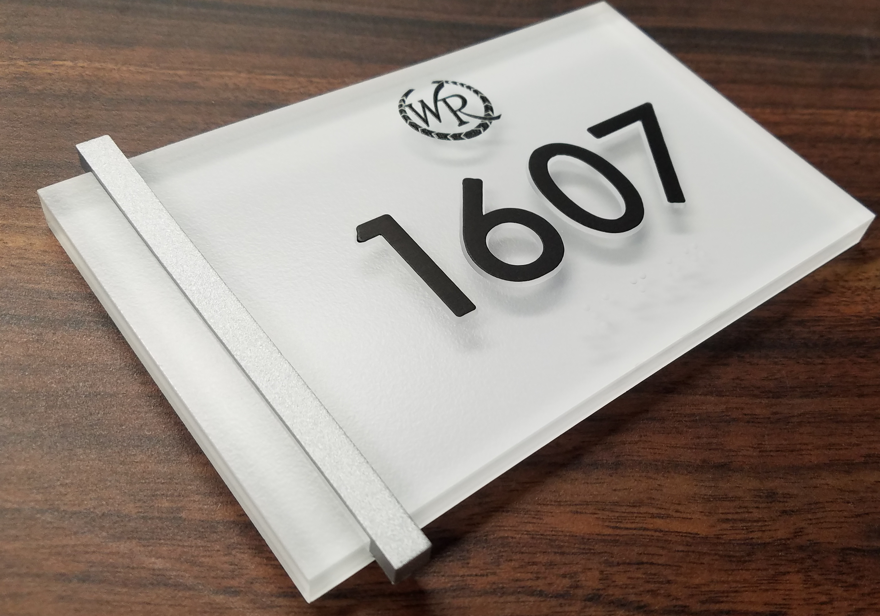
Every sign in a hotel doesn’t have to have tactile characters and Braille. These rules apply to permanent room identification signs: signs that identify a space by name or number at the entrance. Here’s a detailed, but not complete, checklist:
- Guest room number signs: required on every guest room, including accessible rooms
- Accessible room identification signs: rooms designed as accessible must be identified as such
- Restroom identification signs: both public and guest-floor restrooms require compliant ADA signage
- Elevator floor designation signs: hoistway signs on either door jamb at every floor
- Exit and stairwell identification signs: exit signs and stairwell door signs must be compliant
- Conference and meeting room signs: any permanently named space requires compliant signage
- Fitness centers, pool areas, and business centers: permanent amenity rooms must adhere to the same rules
If you’re not sure, think about it this way: If the room has a permanent name or number and is guest accessible, the sign at the door needs to comply with ADA hotel room signage requirements.
ADA Hotel Signs vs. Decorative Hotel Signs
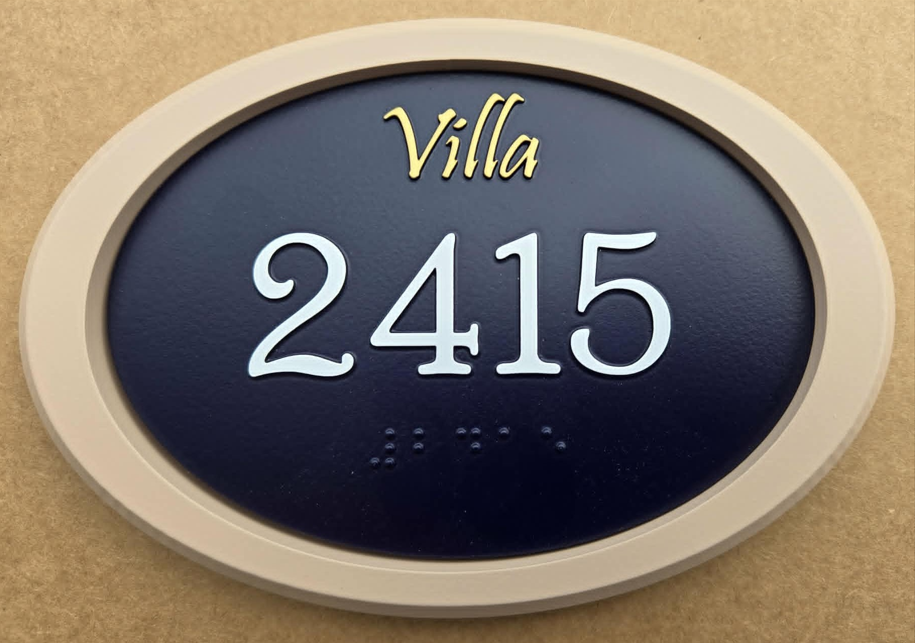
ADA signs vs. decorative signs can be a point of confusion on hotel projects, especially when the designer is trying to stick to a specific aesthetic throughout the property. However, the distinction between the two is simpler than it sounds.
Permanent room identification signs must always be ADA-compliant. If the sign identifies a specific room or space as a permanent fixture, it must include tactile characters, Grade II Braille, compliant contrast, and proper mounting.
Temporary signage does not require tactile text. A paper insert in a frame outside a conference room indicating the day’s meeting schedule, which is temporary and subject to change, does not have to be compliant. The same goes for promotional signage, event banners, and menu boards. The permanent sign identifying the room itself is what must comply.
Directional signage goes by different rules. A sign telling guests where the pool or elevator is counts as directional signage, not an identification sign. Directional signs do not require tactile characters or Braille unless they also serve as permanent room identifiers. However, they must still meet the contrast and visibility standards.
You can prevent under- or over-ordering signage by knowing the project scope upfront. If you’re not sure, give us a call; we’d love to help.
Choosing ADA-Compliant Hotel Signs
ADA hotel signage requirements may seem restrictive, but that doesn’t put your signage outside the realm of reflecting the property’s brand identity while remaining compliant. Here’s what you need to consider:
Material Options
Bellco manufactures ADA hotel signs in several materials. Making the right choice depends on your property’s aesthetic direction, budget, and environment. Photopolymer is the industry standard, and for good reason: It accepts surface or subsurface paint in almost any color, supports small logo details, and can be mounted directly or used as a flexible lens insert in a frame system. Additionally, our thermoformed signs are well-suited for properties that need a richer, more textured look. As solid acrylic construction (not layered materials), they don’t delaminate and hold up well in non-climate-controlled areas and exterior-adjacent locations, such as pool corridors or parking garages. We also offer Vista and JRS frame systems with ADA-compliant inserts, allowing the sign face to be swapped out while keeping the frame in place if room designations change. This is a great option for hotels that already have aluminum-frame hardware installed or just want to upgrade to more modular, brandable signage.
Custom Fabrication & Brand Consistency
Continuity in signage across locations helps maintain brand consistency and communicates a certain level of professionalism to your guests. Custom fabrication means the font on your room number signs matches your brand’s typeface (within ADA constraints), the background color matches your design system, and the sign dimensions fit your door hardware profile. Compliance and brand identity are not mutually exclusive: They just require an experienced manufacturer who knows how to apply both.
Durability in Hospitality Environments
Hotel signage needs to be durable. Between guests and bellhops bumping into corridor walls with luggage carts, housekeeping running into them with cleaning carts, and more, high-traffic areas experience more wear than a standard office building. The material and finish you choose should hold up to your hotel’s environment, whether it’s seaside with a lot of damp, salty air or mountainside with harsh, snowy winds. A sign that fades, chips, or loses its tactile raise within a couple of years is a maintenance liability and a compliance problem.
ADA Hotel Sign Installation Best Practices
Specifying the right sign is only half the job. Installation errors can take products from compliant to noncompliant just by how and where they’re fixed. Here’s what experienced contractors and project managers need to pay attention to:
-
Standardize mounting height across the entire property.
Pick a height within the 48″–60″ range and apply it consistently across the entire property. Guest room hallways, in particular, benefit from this visual uniformity since they feature many signs closely together. When signs are at the same height throughout, they’re easier to locate for guests with low vision. Inspectors will be sure to notice the consistency, too.
-
Verify latch-side clearance before installation.
On a standard hotel room door, the latch side is straightforward. On the other hand, rooms with double doors, sliding doors, or non-standard hardware configurations should have the latch side determined before the sign location is marked. Repositioning becomes messy once anchor holes have been made.
-
Clear the 18″ floor space requirement.
Decorative elements such as furniture and luggage racks can sometimes encroach on a sign’s floor space. While the sign may be mounted correctly, what’s in front of it may be noncompliant. Coordinate with interior design on hotel furniture placement, especially for narrow corridors, to make sure the 18″ floor space requirement is adhered to.
-
Coordinate sign delivery with the construction schedule.
Signs should go up after the wall finishes are complete, but before furniture and fixture installation, to prevent closing off access. A clean install during the right construction window helps you avoid expensive mistakes and long delays caused by installing signage around finished furniture and tight staging.
Work with an ADA Hotel Signage Specialist
Bellco has supplied ADA hotel signs to contractors, procurement teams, and sign companies across the country for decades. Our team has a deep understanding of the hospitality environment: The brand constraints, volume requirements, construction timelines, and compliance details that matter when a property is going through an inspection.
Here’s what we bring to hotel signage projects:
- Design consultation to match ADA requirements with your brand standards
- Compliance verification so your sign selection meets current ADAAG specifications before production
- Custom fabrication across photopolymer, thermoformed, injection molded, vista and JRS systems, and other architectural materials
- Wholesale pricing for contractors and procurement teams ordering at volume
- Nationwide shipping with experience coordinating multi-phase hotel project deliveries
Whether you’re outfitting one property or multiple, getting your signage right the first time pays off. Bellco makes it straightforward to design, order, and receive ADA-compliant hotel signs that coincide with your design goals.
Get started by downloading the Wholesale ADA Catalog or contact our team directly to discuss your project.