
ADA Elevator Signage Requirements
What Is ADA Elevator Signage?
An ADA elevator sign is a tactile and Braille sign mounted at an elevator entrance to help people with visual impairments navigate public buildings. They’re federally required, not decorative.
Under the ADA Standards for Accessible Design, specifically section 407, buildings with elevators are required to post compliant elevator ADA signage at each elevator shaft entrance. These signs must include raised characters, Grade 2 Braille, and meet precise mounting, sizing, and contrast specifications.
Most contractors and facility managers are aware of the broad strokes of ADA compliance, but ADA elevator signs can be one of those areas where the devil is in the details. If you get the Braille translation wrong, mount the sign an inch too high, or forget a floor entirely, you’re looking at a serious gap in compliance.Bellco has been in business since 1946, and we were producing ADA signage even before the 1990 law requiring them. We know the code, and we know where most projects fall short.
Why ADA Elevator Signage Is Required
The Americans with Disabilities Act, Title III, requires that public places be accommodating and accessible to people with disabilities. Elevators fall under that umbrella, meaning commercial buildings, hospitals, hotels, schools, government facilities, and multi-family housing complexes are all required to meet the standard if they have elevators.
ADA compliance requirements should not be taken lightly. Buildings that skip or install elevator ADA signage improperly could face legal trouble: formal ADA complaints, civil lawsuits, and failures during accessibility inspections. Additionally, beyond legal risk, it should be taken into account that these signs exist for a practical reason: people who are blind or have low vision need tactile and Braille floor markers to know which floor they’re on. Without them, getting around becomes frustrating and dangerous.
Compliance also protects building owners and contractors from future liability. New construction, renovations, and tenant improvements are all events that would warrant an ADA review. Getting the signage right the first time around is much cheaper than retrofitting it after an inspection or complaint.
ADA Elevator Signage Requirements: Technical Breakdown
For contractors and those needing ADA elevator signage, here’s what you need to know. These are what the ADA Standards for Accessible Design (Section 407) require for elevator signage. We’ve broken it down into clear categories.
Elevator Entrance (Hoistway) Sign Requirements
Signs at elevator entrances, known as hoistway signs, must meet all of the following:
- Installed on at least one jamb of the elevator hoistway door at each floor
- Must include the floor name/number in raised tactile characters
- Must include Grade 2 Braille floor number translation
- Raised characters must be a minimum of 2″ in height for floor identification
- Signs must provide sufficient contrast between characters and the background
- Where applicable, the pictogram field must have a minimum 6″ vertical field
A few things to note: both jambs mean both sides of the door opening on every floor. Don’t skip a floor because it’s a service level or mechanical floor; this is a common mistake. If an elevator stops there, ADA elevator signage is required.
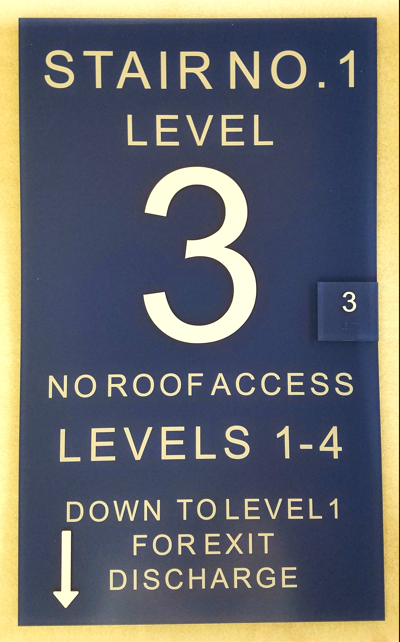
Tactile Character Requirements
The tactile portion of an ADA elevator sign follows strict formatting rules:
- Characters must be sans serif font (no decorative typefaces)
- Where applicable, uppercase lettering is required for tactile characters
- Characters must be raised a minimum of 1/32″ above the sign surface
- Character spacing must follow ADA guidelines for touch legibility
- Stroke width must be between 10 and 30 percent of the character height
These rules should be followed to the letter. Font choice, raised height, and spacing all contribute to whether a sign is actually readable by touch. A sign that looks right but has the wrong stroke width or a slightly serif font can result in a failed inspection.
Tactile Character Requirements
The tactile portion of an ADA elevator sign follows strict formatting rules:
- Characters must be sans serif font (no decorative typefaces)
- Where applicable, uppercase lettering is required for tactile characters
- Characters must be raised a minimum of 1/32″ above the sign surface
- Character spacing must follow ADA guidelines for touch legibility
- Stroke width must be between 10 and 30 percent of the character height
These rules should be followed to the letter. Font choice, raised height, and spacing all contribute to whether a sign is actually readable by touch. A sign that looks right but has the wrong stroke width or a slightly serif font can result in a failed inspection.
Braille Requirements for Elevator Signs
All compliant ADA elevator signs must include a Braille translation. The specific requirements are:
- Grade 2 Braille is required (contracted Braille, not uncontracted)
- Braille must be positioned exactly below the corresponding tactile text
- Dot diameter must be between 0.059 and 0.063 inches
- Dot spacing must conform to ADA standards for dot-to-dot and cell-to-cell measurements
- The Braille translation must be an exact match for the tactile wording
Grade 2 Braille uses contractions and abbreviations to condense information, making it faster to read for experienced users. Even if it’s technically readable, using Grade 1 (uncontracted) Braille is out of compliance.
Mounting Height & Placement Rules
Proper mounting is one of the ADA elevator signage requirements that people misunderstand the most. These rules also apply to other permanent room signs, including ADA restroom sign elevation standards, so the same rules should be followed across a project.
- The baseline of the highest tactile character must be no more than 60″ above the finished floor
- The baseline of the lowest tactile character must be at least 48″ above the finished floor
- Signs should be mounted on the latch side of the door as long as the door configuration allows
- Maintain 18″ of clear floor space in front of the sign for a forward approach
- Signs cannot be mounted behind any obstruction, door swing, or architectural feature that would block access
Further explanation: the 48″–60″ mounting range is designed to be reachable for someone in a wheelchair and readable by touch without requiring much reaching or bending. On elevator hoistways, the latch-side placement guideline applies where there is a defined latch side; for doors that open at the center, you can use either jamb.
Elevator Car Interior Signage Requirements
Don’t forget about the signage inside the elevator cab itself: Signage requirements don’t stop at the hallway. Interior ADA elevator signage must follow these rules:
- All control buttons must be labeled in Braille and raised print, including floor numbers, door open/close, alarm, and emergency buttons
- Emergency communication systems must be labeled with tactile and Braille characters
- Floor numbers must be raised and appear next to or on each floor button
- Visual and audible floor indicators are required to announce floor arrivals for passengers with visual impairments
Oftentimes, elevator car interior signage is handled by the elevator manufacturer, but contractors and building owners are responsible for making sure it’s present and compliant before a certificate of occupancy can be issued. If the cab signs are missing or non-compliant, it’s still your responsibility.
ADA Elevator Signs vs. Other ADA Signs
People usually think there isn’t much difference between elevator signage and standard room and restroom identification signs; however, the mounting rules are different. Understanding the distinction is important, especially on projects where you’re managing multiple kinds of signs.
Restroom signs: ADA restroom sign elevation should be between 48″ and 60″ above the floor, and the sign should be mounted on the latch side of the restroom door. The ADA restroom sign elevation follows the same vertical range as elevator signs, but restroom signs go on the wall beside the door, not on the door frame itself.
Elevator hoistway signs: As permanent identifiers, not just directional signs, these signs should be mounted directly on the door jambs at the elevator entrance, on both sides, on every floor.
Wayfinding vs. permanent room identification: These fall into different categories. Directional signs (that point visitors toward elevators, restrooms, or exits) don’t require tactile characters or Braille unless they’re also designated as permanent room identification signs. A sign that simply says “Elevators This Way” with an arrow is not treated the same as a sign on the actual elevator jamb.
Clarifying these categories before beginning a project can help prevent this common mistake: ordering the wrong sign type for the wrong location.
Which Buildings Must Have ADA Elevator Signs?
If the building has an elevator and is covered under the ADA, it must have elevator signage. This includes:
- Commercial office buildings
- Hospitals and medical facilities
- Hotels and hospitality properties
- Multi-family residential buildings (condos, apartments) with elevators
- Schools, colleges, and universities
- Government and municipal buildings
- Retail centers and shopping malls
- Transportation facilities (airports, train stations)
Private residences are generally exempt, but any commercial or mixed-use property with public access is covered by Title III of the ADA. Historic buildings have some flexibility around alterations, but new construction and significant renovations must comply with the full standard.
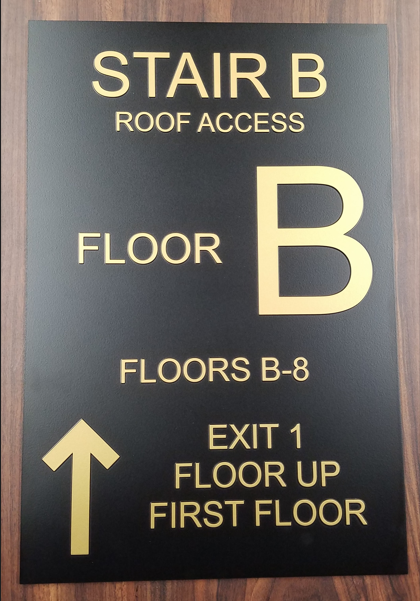
ADA Elevator Sign Installation Best Practices
Meeting the minimum requirements makes you compliant. Following these installation best practices goes the extra mile to cover all your bases.
-
Be consistent across floors.
Install signs at the same height on every floor. Even if the code gives you a range, pick a standard measurement and use it consistently. Avoid the confusion that inconsistent placement creates for users. It also just looks sloppy during inspections.
-
Account for trim and architectural features.
Door trim and decorative molding can push signs into non-compliant positions or block the required clear floor space. Observe the jamb locations during framing, rather than after finishes are installed, to avoid compliance problems.
-
Plan for the door swing.
On latch-side installations, ensure the sign placement doesn’t fall behind the door when the door is fully open. The sign needs to be visible and accessible regardless of the door’s position.
-
Coordinate with the elevator contractor.
Interior elevator ADA signage and hoistway signs should be installed during the same phase, if possible. Aligning the install timing means fewer site visits and ensures both the interior and exterior signage get reviewed together.
-
Order by floor count, not by unit.
If you’re in charge of a multi-story building project, calculate the total sign count before ordering. You need two jamb signs per floor, per elevator. So, a six-story building with two elevator banks requires a minimum of 24 hoistway signs. Ordering by project rather than as needed keeps costs down and ensures signage is consistent throughout the building.
Work with an ADA Elevator Signage Specialist
Bellco has been manufacturing ADA and architectural signage since 1946. We supply contractors, sign shops, facility managers, and distributors nationwide with wholesale elevator ADA signage that meets current ADA standards. Whether you’re pricing a single building or you’re outfitting a multi-site portfolio, we can help.
What we offer:
- Compliance consultation to review your project specifications before you order.
- Custom fabrication across multiple materials, including photopolymer, cast metal, acrylic, and more.
- Wholesale pricing for contractors and sign companies that order in volume
- Nationwide support with a team that knows the ADA code and can answer any technical questions.
- A full line of ADA signage, including restroom, exit, wayfinding, and room ID signs.
We make it easy to spec, order, and receive ADA elevator signs that are built to code and ready to install. Our wholesale catalog includes everything from standard hoistway signs to full building sign packages. Contact Bellco today to request a quote or speak with one of our specialists about your next project.